NCE Practice Exam & CPCE Study Guide. Pass the National Counselor Exam.
Adaptive NCE practice questions. NCMHCE prep. Study smarter.
Know exactly what to study next — every day. Adaptive practice, SM-2 flashcards, full mock exams, and an AI tutor in one focused study tool.
Adaptive practice
Questions get harder where you're weak and re-surface what you missed.
Spaced flashcards
SM-2 spaced repetition so concepts stick before exam day.
Full mock exams
200-question NCE and 160-question CPCE under real exam timing.
AI tutor
Explain any theorist, code, or stats topic in plain English.
A study loop that actually moves the needle.
Three steps that turn scattered study sessions into measurable progress on the NCE and CPCE.
- 01
Diagnose your weak spots
Take an adaptive baseline. CounPass maps your performance across all 8 CACREP domains so you know exactly where to start.
- 02
Practice with adaptive questions
Questions get harder where you're strong and re-surface what you missed. Spaced-repetition flashcards lock concepts into long-term memory.
- 03
Track readiness, then prove it
Watch your domain scores climb in real time, then sit a full-length timed mock exam to confirm you're exam-day ready.
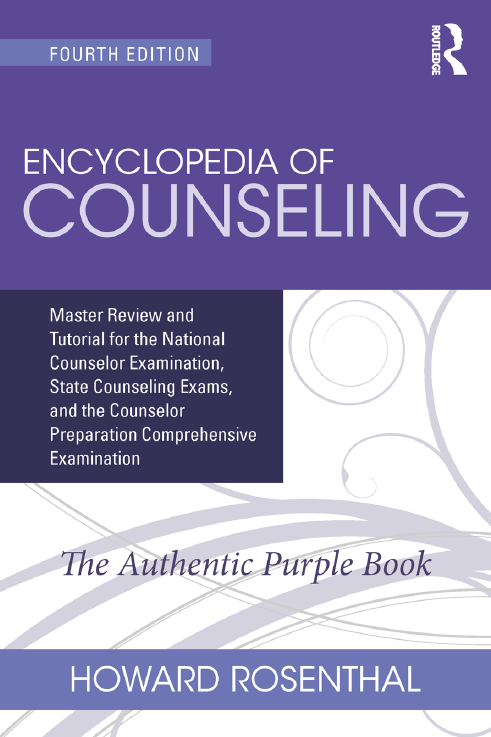
Aligned with the Purple Book (4th ed.) Encyclopedia of Counseling: Master Review and Tutorial for the National Counselor Examination, State Counseling Exams, and the Counselor Preparation Comprehensive Examination
Every practice question, flashcard, and mock exam is aligned with Encyclopedia of Counseling (4th Edition) by Howard Rosenthal — the trusted "Purple Book" used by counseling students preparing for the NCE, CPCE, and state counseling exams.
Master Review and Tutorial for the National Counselor Examination, State Counseling Exams, and the Counselor Preparation Comprehensive Examination.
NCE vs. CPCE — everything in one place
The two main exams counseling students sit for, compared side by side. Verified against the official NBCC and CCE handbooks.
| Attribute | NCELicensure exam — NBCC National Counselor Exam Official site ↗ | CPCEProgram exit exam — CCE Counselor Preparation Comprehensive Exam Official site ↗ |
|---|---|---|
Format | 200 questions 160 scored + 40 unscored pretest items, all multiple choice. | 160 questions 136 scored + 24 pretest — 20 per CACREP area, all multiple choice. |
Time limit | 4 hours Single continuous testing window. | 4 hours Single continuous testing window. |
Purpose | Licensure exam Required for the NCC credential and counselor licensure in most U.S. states. | Program exit exam Used by 400+ counselor-education programs as a comprehensive assessment. |
Passing score | ~95–105 / 160 Criterion-referenced cut score set by NBCC for each test form. | Set by program Each institution sets its own cut score — no single national threshold. |
Where you take it | Pearson VUE Computer-based at a testing center, or remote via OnVUE in some cases. | On campus Administered by your counseling program (computer or paper). |
Cost | $275 NCC application fee. State licensure fees are separate and vary. | $80–$110 Set by your program / institution — fees vary by school. |
Retakes | 90-day wait New application and fee required for each retake attempt. | Program decides Retake policy and timing is set by your individual program. |
Score report | Pass / fail Includes subscores across the 8 CACREP content areas. | Subscores + norms Per-domain subscores compared to national normative data. |
160 scored + 40 unscored pretest items, all multiple choice.
136 scored + 24 pretest — 20 per CACREP area, all multiple choice.
Single continuous testing window.
Single continuous testing window.
Required for the NCC credential and counselor licensure in most U.S. states.
Used by 400+ counselor-education programs as a comprehensive assessment.
Criterion-referenced cut score set by NBCC for each test form.
Each institution sets its own cut score — no single national threshold.
Computer-based at a testing center, or remote via OnVUE in some cases.
Administered by your counseling program (computer or paper).
NCC application fee. State licensure fees are separate and vary.
Set by your program / institution — fees vary by school.
New application and fee required for each retake attempt.
Retake policy and timing is set by your individual program.
Includes subscores across the 8 CACREP content areas.
Per-domain subscores compared to national normative data.
Both exams cover the same 8 CACREP content areas
- Human Growth & Development
- Social & Cultural Diversity
- Helping Relationships
- Group Counseling & Group Work
- Career Development
- Assessment & Testing
- Research & Program Evaluation
- Professional Counseling Orientation & Ethical Practice
Frequently asked
Fees, cut scores, and policies can change. Always confirm the latest details with NBCC (NCE) or CCE (CPCE) before applying.
Built around the 8 CACREP domains.
Every question, flashcard, and tutor session is tagged so you can see exactly where you stand — and what to study next.
- Helping Relationships
- Ethics & Professional Orientation
- Human Growth & Development
- Group Counseling & Group Work
- Career Development
- Assessment & Testing
- Social & Cultural Diversity
- Research & Program Evaluation
Help keep prep free for the next student.
CounPass is built by counselors, for counselors. If we've helped your prep, chip in — every donation funds new practice questions and covers the AI tutor's compute.
One-time or monthly. Not tax-deductible.
Support CounPass
Keeps free practice free for the next student.
Secure checkout by Stripe. Not tax-deductible.